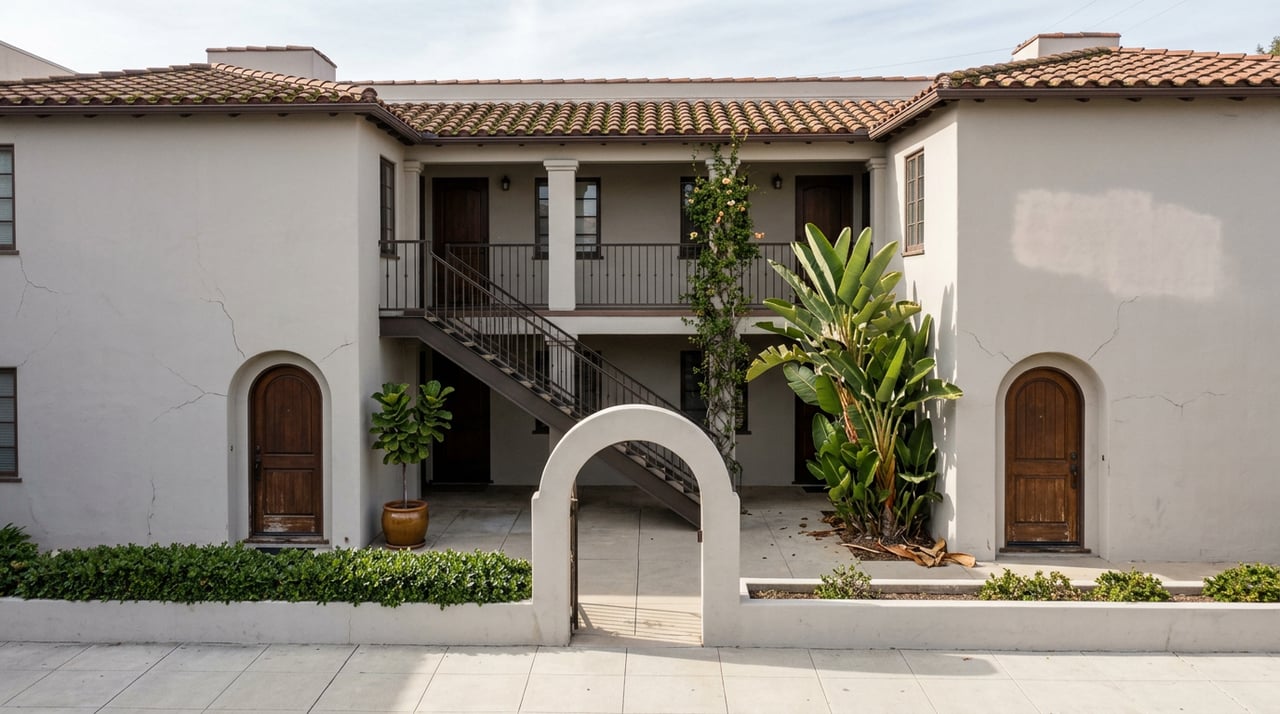
A buyer who put an offer on a 14-unit pre-1979 building near Crescent Heights this summer ran into a problem that had nothing to do with the roof or the parking count. The registered Maximum Allowable Rent on half the units did not match what the seller's rent roll said the tenants were paying. According to Borna Houman Law, a new owner of a 14-unit pre-1979 building on Crescent Heights may inherit inconsistent registered MARs across units, and rebaselining requires petition work with the city's Rent Stabilization Division. That is not a hypothetical. It is the kind of detail that only shows up once you are actually in escrow on a West Hollywood income property, and it is the reason underwriting here can't be copied from a Culver City or Hollywood deal.
If you are actively pricing a small multifamily building in West Hollywood right now, in September 2026, there is a second, more immediate problem. The rent cap you modeled this summer already changed, and the city is reviewing proposed changes to how it enforces parts of the ordinance. Both are happening while your due diligence clock is running.
Two Ordinances, One Address, Different Rules
The first thing worth confirming before you run a single cap rate calculation is which rent stabilization law actually governs the building. West Hollywood is an independent city, incorporated in 1984, with its own Rent Stabilization Ordinance administered by its own Rent Stabilization Commission. It is not part of the City of Los Angeles, and its rules are not the same as the Los Angeles Rent Stabilization Ordinance that covers apartment stock a few blocks away in Hollywood proper.
The construction cutoff dates alone catch people. The West Hollywood Municipal Code generally applies to multi-family buildings that received a certificate of occupancy before July 1, 1979. The Los Angeles Housing Department identifies October 1, 1978 as the City of Los Angeles cutoff for its own rent-stabilized stock, three months earlier. A building that falls in that narrow window can be covered under one jurisdiction's logic and treated differently under the other's, which is exactly the kind of detail a broker who is used to working LA City deals can get wrong on a West Hollywood file.
There is also a tax consequence that has nothing to do with rent control but shapes every seller's math. Measure ULA is a City of Los Angeles transfer tax surcharge on high-value sales, so a property's jurisdiction matters in assessing it.
The Number That Just Moved
WEHOonline reports that West Hollywood's Annual General Adjustment, the formula that sets how much a landlord can raise rent on a stabilized unit each year, is calculated at 75 percent of the regional Consumer Price Index, with a permanent ceiling of 3 percent written into the municipal code. For the period running from September 1, 2025 through August 31, 2026, that adjustment was 2.25 percent. As of September 1, 2026, it rose to 2.75 percent, the figure the city's Rent Stabilization Commission announced in late June after walking through the CPI math at its public meeting.
That half-point move matters more than it looks. The city froze rents on stabilized units in April 2020 and kept the freeze in place for close to three years. When the freeze lifted, the formula would have produced a 6 percent adjustment, the highest in the ordinance's history. The City Council cut that number in half and wrote the permanent 3 percent cap into the code so a shock like that couldn't happen again. The 2.75 percent figure sits close to that ceiling, which tells you the formula is now running near its legal maximum rather than in the softer range it occupied for most of the past two years.
Relocation fees, the payments a landlord owes a tenant displaced through no fault of their own, moved on the same schedule. Effective July 1, 2026, those payments rose to $9,763 for a studio, $13,787 for a one-bedroom, and $18,571 for a two-bedroom. If your acquisition plan involves an owner move-in, a substantial remodel, or any no-fault vacancy, those are the real numbers to underwrite against, not last year's schedule.
| West Hollywood RSO | City of Los Angeles RSO | |
|---|---|---|
| Construction cutoff | Before July 1, 1979 | October 1, 1978 |
| Administering body | West Hollywood Rent Stabilization Commission | LA Housing Department |
| Annual increase cap (period shown) | 2.75% (effective Sept 1, 2026) | LAHD: 3% through June 30, 2026 |
| Measure ULA exposure | Outside LA City | Depends on transaction value |
| Share of housing that is renter-occupied | Roughly 80% of households | Varies by neighborhood |
The City Is Reviewing Other Ordinance Changes This Month
The rent cap is not the only thing in motion. West Hollywood's Ad Hoc Committee on Rent Stabilization, made up of Mayor John Heilman and Councilmember Chelsea Byers, brought a set of proposed enforcement changes to the City Council on July 20 as a policy discussion, not yet a vote to adopt. According to the California Apartment Association's coverage of that meeting, the proposals under review include shifting the city from a complaint-driven enforcement model to one with proactive monitoring and data tracking, potentially barring rent increases while code violations sit unresolved, tighter verification requirements for owner-occupancy evictions with repeat post-move-in site visits, and new parking replacement rules tied to ADU and seismic retrofit construction. Staff set no adoption timeline and described a phased approach, with ordinance language to follow only if the Council decides it wants specific changes drafted.
The city is gathering public input on a related but narrower set of technical fixes throughout September. A tenant session already took place on September 2 at the Kings Road Park Community Meeting Room. A virtual landlord session was scheduled for September 9; a virtual tenant session is scheduled for September 23, and an in-person landlord session back at Kings Road Park on September 30. Registration for the September 23 virtual tenant session runs through the city's Engage WeHo portal. The items on the table there include whether landlords should be required to actually restore a lost housing service like laundry or parking rather than just accept a rent reduction, and whether owner or family move-in evictions need longer notice periods. City staff has been clear this round is not a full rewrite of the ordinance, but it is a live process, and a buyer closing escrow in October is closing into whatever the Council decides to do with it.
What This Actually Does to Your Cap Rate
West Hollywood apartment buildings have been trading at cap rates roughly between 4.0 and 5.0 percent, with the tighter end of that range concentrated on the residential blocks between Santa Monica Boulevard and Melrose and on the hillside streets above the Sunset Strip. Buildings carrying heavier rent stabilization exposure or deferred maintenance trade closer to the wider end. Price per unit generally runs from $350,000 to $550,000. That range already prices in a known regulatory ceiling, the assumption that landlords can count on roughly 2 to 3 percent annual rent growth on stabilized units and a predictable, complaint-driven enforcement posture from the city.
What changed this month is that both halves of that assumption moved at once. The growth rate ticked up a half point, which helps NOI projections modestly. The enforcement posture is under active reconsideration, which does not show up in a spreadsheet but does show up in how much diligence a new owner needs to do before assuming a building's current registration and habitability status will hold without incident. A buyer who prices the asset purely on last year's 2.25 percent AGA and a complaint-driven enforcement model is pricing a market that no longer exists as of September 1.
A Few Questions Worth Asking Before You Close
Does Measure ULA apply if I buy a West Hollywood building? The relevant transfer-tax treatment depends on the property's location and sale value, so confirm it with your escrow officer.
How is the West Hollywood ordinance different from the one covering nearby Hollywood buildings? The construction cutoff dates differ by roughly nine months, the enforcement agency is different, and the annual increase formulas are calculated on separate schedules. A broker experienced with LA City RSO deals should not assume the two ordinances line up.
Where can I verify a building's registered Maximum Allowable Rent before closing? The city's Rent Stabilization Division maintains registration records for every covered unit. Given the Crescent Heights example above, confirming that every unit's registered MAR matches the seller's rent roll, and understanding what a rebaseline petition would require if it does not, is worth doing before you remove contingencies rather than after.
West Hollywood's small multifamily market rewards buyers who do this homework and punishes the ones who assume last year's numbers still hold. If you are evaluating a duplex, triplex, or fourplex in West Hollywood and want a second set of eyes on the registration history, the AGA math, and how the current enforcement discussion might affect your hold period, The Alligood Group can walk through the specifics with you. Schedule a Private Consultation before you write the offer, not after.
This article is general information, not legal, tax or financial advice. Consult a qualified professional about your situation.